Postagens

Mostrando postagens com o rótulo powerlaws

A ideologia das leis de potência

Imagem
Power Laws, Weblogs, and Inequality First published February 8, 2003 on the "Networks, Economics, and Culture" mailing list. Subscribe to the mailing list. Version 1.1: Changed 02/10/03 to point to the updated "Blogging Ecosystem" project, and to Jason Kottke's work using Technorati.com data. Added addendum pointing to David Sifry's "Technorati Interesting Newcomers" list, which is in part a response to this article. A persistent theme among people writing about the social aspects of weblogging is to note (and usually lament ) the rise of an A-list, a small set of webloggers who account for a majority of the traffic in the weblog world. This complaint follows a common pattern we've seen with MUDs, BBSes, and online communities like Echo and the WELL. A new social system starts, and seems delightfully free of the elitism and cliquishness of the existing systems. Then, as the new system grows, problems of scale set in. Not everyone can partic...

Leis de escala e criticalidade em ciências cognitivas

doi:10.1016/j.tics.2010.02.005 | How to Cite or Link Using DOI Copyright © 2010 Elsevier Ltd All rights reserved. Permissions & Reprints Review Scaling laws in cognitive sciences Christopher T. Kello1, , Gordon D.A. Brown2, Ramon Ferrer-i-Cancho3, John G. Holden4, Klaus Linkenkaer-Hansen5, Theo Rhodes1 and Guy C. Van Orden4 1 Cognitive and Information Sciences University of California , Merced, 5200 North Lake Rd., Merced, CA 95343, USA 2 Department of Psychology, University of Warwick, Coventry CV4 7AL, United Kingdom 3 Department de Llenguatges i Sistemes Informatics, Universitat Politecnica de Catalunya, Campus Nord, Edifici Omega, Jordi Girona Salgado 1-3, 08034 Barcelona, Catalonia, Spain 4 Center for Perception, Action and Cognition, Department of Psychology, University of Cincinnati, PO Box 210376, Cincinnati, OH 45221-0376, USA 5 Department of Integrative Neurophysiology, VU University Amsterdam, De Boelelaan 1085, 1081 HV Amsterdam, the Netherlands Available online 1 Apri...

Lei de Benford e Física Estatística

Imagem
Benford's Law And A Theory of Everything Posted: 06 May 2010 09:10 PM PDT A new relationship between Benford's Law and the statistics of fundamental physics may hint at a deeper theory of everything In 1938, the physicist Frank Benford made an extraordinary discovery about numbers. He found that in many lists of numbers drawn from real data, the leading digit is far more likely to be a 1 than a 9. In fact, the distribution of first digits follows a logarithmic law. So the first digit is likely to be 1 about 30 per cent of time while the number 9 appears only five per cent of the time. That's an unsettling and counterintuitive discovery. Why aren't numbers evenly distributed in such lists? One answer is that if numbers have this type of distribution then it must be scale invariant. So switching a data set measured in inches to one measured in centimetres should not change the distribution. If that's the case, then the only form such a distribution can take is logar...

Avalanches Neuronais estão decolando...

Imagem
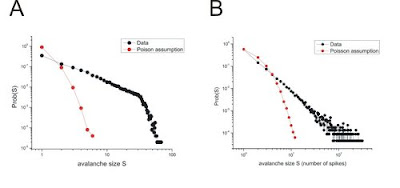
Dietmar Plenz escreveu para o Mauro de que nossos trabalhos tem sido bem recebidos e que "o avião está decolando..." Neuronal avalanches imply maximum dynamic range in cortical networks at criticality Authors: Woodrow L. Shew , Hongdian Yang , Thomas Petermann , Rajarshi Roy , Dietmar Plenz (Submitted on 2 Jun 2009 ( v1 ), last revised 10 Jun 2009 (this version, v2)) Abstract: Spontaneous neural activity is a ubiquitous feature of the brain even in the absence of input from the senses. What role this activity plays in brain function is a long-standing enigma in neuroscience. Recent experiments demonstrate that spontaneous activity both in the intact brain and in vitro has statistical properties expected near the critical point of a phase transition, a phenomenon called neuronal avalanches. Here we demonstrate in experiments and simulations that cortical networks which display neuronal avalanches benefit from maximized dynamic range, i.e. the ability to respond to t...

Estudando a blogosfera

Imagem
Macroscopic and microscopic statistical properties observed in blog entries Authors: Yukie Sano , Misako Takayasu (Submitted on 9 Jun 2009) Abstract: We observe the statistical properties of blogs that are expected to reflect social human interaction. Firstly, we introduce a basic normalization preprocess that enables us to evaluate the genuine word frequency in blogs that are independent of external factors such as spam blogs, server-breakdowns, increase in the population of bloggers, and periodic weekly behaviors. After this process, we can confirm that small frequency words clearly follow an independent Poisson process as theoretically expected. Secondly, we focus on each blogger's basic behaviors. It is found that there are two kinds of behaviors of bloggers. Further, Zipf's law on word frequency is confirmed to be universally independent of individual activity types. Comments: 10 pages, 14 figures Subjects: Physics and Society (physics.soc-ph) Cite as...

Erramos: Raios não derrubam aviões

O bom do uso de blogs e janelas de comentários é que as informações podem ser rapidamente corrigidas. Eu reproduzi em outro post o anúncio da Air France de que um raio poderia ter derrubado o avião. Roberto Takata e João Carlos rapidamente me chamaram a atenção de que isso é improvável (e eu realmente dei marcada, porque aviões são gaiolas de Faraday, e eu deveria saber isso. Um texto sobre isso pode ser encontrado aqui . Fica a curiosidade sobre por que a Air France teria solto esta informação exdrúxula. A menos que tenham informações internas (uma da "caixas pretas" da aeronave envia online informações técnicas (centenas de parâmetros) via satélite para a central da Air France. Uma especulação minha seria sobre a magnitude dos raios. Será que alguém já traçou uma distribuição de  magnitude (energia liberada?)  dos raios? Eu aposto que dá uma lei de potência, porque raios parecem lembrar avalanches com características fractais.  Em termos de extensão espacial, eu sei que rel...

Porcos, Cisnes e pseudociência

Imagem
Este post pertence à Roda de Ciência, tema de abril. Deixe seus comentários lá, por favor. TEORIA DO CISNE NEGRO Antes de a Austrália ser descoberta, todos os cisnes do mundo eram brancos. A Austrália, onde existe o cisne negro (´cygnues atratus´), mostrou a possibilidade de uma exceção escondida de nós, da qual não tínhamos a menor idéia. 2. O meu cisne negro não é um pássaro, mas um evento com três características: 1ª) altamente inesperado; 2ª) tem grande impacto; e 3ª) depois de acontecer, procuramos dar uma explicação para fazê-lo parecer o menos aleatório e o mais previsível. 3. O cisne negro explica quase tudo no mundo, como a Primeira Grande Guerra. Era imprevisível, mas, depois de sua ocorrência, as suas causas pareceram óbvias para as pessoas. O mesmo aconteceu com a Segunda Grande Guerra. Esses fatos provam a incapacidade de a humanidade prever grandes eventos. 4. Mais recentemente, a internet é um cisne negro. Surgida como ferramenta de comunicação militar, ela transformou o...

Quando dar oprtunidades iguais é injusto

Imagem
OK, OK, já comentei que a Política, assim como a Arte, não pode ser reduzida à Ciência. Mas isso não implica que não existam relações e influências. Por exemplo, a Política, e as políticas públicas, são muito influenciadas pelos cientistas sociais e economistas (mesmo que estes sejam considerados por alguns céticos como pseudocientistas). Na questão da origem e mecanismos de mudança da distribuição de renda, os físicos têm dado uma contribuição interessante. Basta fazer uma busca no ArXiv sobre whealth distribution. Aqui um exemplo interesante, do pesoal da UFRGS: Versão final e referência aqui . E aqui o artigo com o copyleft do ArXiv : The unfair consequences of equal opportunities: comparing exchange models of wealth distribution Authors: G. M. Caon, S. Goncalves, J. R. Iglesias (Submitted on 1 Nov 2006) Abstract: Simple agent based exchange models are a commonplace in the study of wealth distribution of artificial societies. Generally, each agent is characterized by its wealt...

Lei de Clausewitz vale para ataques terroristas

Imagem
Sobre Clausewitz ver aqui . Via Physics ArXiv Blog (quem será o KFC? Um físico desempregado? É impossível que um professor ou estudante tenha tanto tempo para ler os papers, blogar e escrever bem assim!): Plot the number of people killed in terrorists attacks around the world since 1968 against the frequency with which such attacks occur and you’ll get a power law distribution, that’s a fancy way of saying a straight line when both axis have logarithmic scales. The question, of course, is why? Why not a normal distribution, in which there would be many orders of magnitude fewer extreme events? Aaron Clauset and Frederik Wiegel have built a model that might explain why. The model makes five simple assumptions about the way terrorist groups grow and fall apart and how often they carry out major attacks. And here’s the strange thing: this model almost exactly reproduces the distribution of terrorists attacks we see in the real world. These assumptions are things like: terrorist groups gro...

Queremos educar nossas crianças para que produzam armas termobáricas?

Imagem
(teclado com problemas nos acentos aqui...) OK, OK, todo mundo sabe que a Ciencia, especialmente a patrocinada pelos militares,  é feita por homens brancos, machistas e ocidentais (Hummmm... eu sempre achei que os homens orientais é que fossem machistas!). Assim, achei curiosa uma reportagem que vi esta semana no canal Turbo (esses canais americanos obcecados por máquinas e tecnologia hard). A reportagem era sobre as armas termobáricas , especialmente desenvolvidas para desencavar Osame Bin Laden (meu xará, o nome dele é com "e" final sim, busque no Google!) das cavernas do Afeganistão. A chefe do Laboratório, que se orgulhava de descrever todo o processo de desenvolvimento da nova arma, é uma mulher vietnamita, ou seja, amarela feminista ocidental! Curioso, curioso, nada New Age... O que falta a muitos cientistas que acham que a associação entre ciencia e tecnologia militar é natural é uma análise do impacto cultural dessas práticas no longo prazo: sim, voce pode ganhar a ba...

Música dos Terremotos

Neurofisiólgos costumam ouvir os spikes de neurônios em aplificadores em em vez de apenas visualizá-los em osciloscópios. Dizem que isso se faz porque o ouvido humano é mais sensível a detetar padrões do que o sistema visual. Idéia: imitando este vídeo, faça uma escala associando magnitudes dos terremotos com tons, de um modo psicofisicamente significativo. Em princípio, se os eventos são descorrelacionados, deveriamos ter apenas uma "música fractal", ou seja, notas musicais tiradas de uma distribuição tipo lei de potência. Mas os pre-shocks, os after-shoks e os terremotos correlacionados ou disparados em avalanches globais produzirias assinaturas que poderiam ser facilmente detetáveis acusticamente. Ou não?

Blogs talentosos versus blogs experientes

Imagem
Acho que seria possível adaptar as idéias deste artigo para ranquear blogs. Vou propor aqui o Kinouchi rank :´) : K = A/N A = autoridade technorati. N = número de visitas nos últimos seis meses. Poderiamos adotar tanto A como K para distinguir os blogs experientes (com tradição) dos blogs talentosos (estrelas ascendentes). Para isso, cada blog teria que se cadastrar no Technorati e no Google Analytics e fornecer esse número de visita na barra lateral. Vou pedir ao Zedy que envie um email para todos os blogs do Anel de Blogs Científicos, com essas recomendações. Mas se você que está lendo isso ainda não está cadastrado nesses sites, seria uma boa idéia fazê-lo, pois teremos que coletar dados por seis meses... Do physics ArXiv Blog : How will the next generation of search engines outperform Google’s all-conquering Pagerank algorithm? One route might be to hire Vwani Roychowdhury at the University of California, Los Angeles and his buddies who have found a fascinating new way to tackl...

Tribo perdida na Galáxia

Um paper um pouco antigo mais interessante, por Ken D. Olum : Conflict between anthropic reasoning and observation Authors: Ken D. Olum (Submitted on 19 Mar 2003 ( v1 ), last revised 4 Feb 2004 (this version, v2)) Abstract: Anthropic reasoning often begins with the premise that we should expect to find ourselves typical among all intelligent observers. However, in the infinite universe predicted by inflation, there are some civilizations which have spread across their galaxies and contain huge numbers of individuals. Unless the proportion of such large civilizations is unreasonably tiny, most observers belong to them. Thus anthropic reasoning predicts that we should find ourselves in such a large civilization, while in fact we do not. There must be an important flaw in our understanding of the structure of the universe and the range of development of civilizations, or in the process of anthropic reasoning. Comments: 7 pages, RevTeX. v2: New "lost colony" section. Correspond...

Ubiquity

Imagem
Como vocês sabem, este não é um blog jornalístico de divulgação científica, mas um "weblog" de viagem na vida científica. Isso quer dizer que vou registrando aqui notícias e referências que vou encontrando nas minhas navegações, idéias para papers, idéias "malucas" que um dia talvez poderiam se mostrar frutíferas, divulgação dos meus trabalhos e dos meus amigos, comentários diversos "sem ciência" e principalmente tudo o que acho que vou esquecer se não anotar. Ah, sim, tem uma dose exagerada de "auto-centrismo" (eufemisticamente falando), mas o blogueiro que não tiver ego que atire a primeira pedra... Bom, hoje, de novo, vou divulgar um livro que recomendo aos meus alunos. Abaixo, meu review na Amazon , escrito sob o pseudônimo literário de B. B. Jenitez: This is the book that I would like to have written. Although being a popular account, it is scientifically accurate and carefull in its suggestions, always informing the reader what is conso...

Critical Mind

Imagem
Para ser lido. Mauro, você já o tinha visto? The brain: What is critical about it? Authors: Dante R. Chialvo , Pablo Balenzuela , Daniel Fraiman (Submitted on 31 Mar 2008) Abstract: We review the recent proposal that the most fascinating brain properties are related to the fact that it always stays close to a second order phase transition. In such conditions, the collective of neuronal groups can reliably generate robust and flexible behavior, because it is known that at the critical point there is the largest abundance of metastable states to choose from. Here we review the motivation, arguments and recent results, as well as further implications of this view of the functioning brain. Comments: Proceedings of BIOCOMP2007 - Collective Dynamics: Topics on Competition and Cooperation in the Biosciences. Vietri sul Mare, Italy (2007) Subjects: Disordered Systems and Neural Networks (cond-mat.dis-nn); Neurons and Cognition (q-bio.NC) Cite as: arXiv:0804.0032v1 [cond-mat.dis-nn]

Fitando Leis de Potência

Imagem
Cosma Shalizi , do Three-Toed Sloat , me enviou um paper de sua autoria com Mark Newman e Aaron Clauset. Alunos de IC, por favor leiam o paper. Talvez valesse a pena marcarmos um journal club sobre ele. Power-law Distributions in Empirical Data This page is a companion for the review article on power-law distributions in empirical data, written by Aaron Clauset (me), Cosma R. Shalizi and M.E.J. Newman . The intention is that this page will host implementations of the methods we describe in the article. For now, these are simply the versions we wrote (in Matlab and R), but our hope is to eventually host versions in a variety of languages. In general, we want to make the methods as accessible to the community as possible.Journal Reference: A. Clauset, C.R. Shalizi, and M.E.J. Newman, " Power-law distributions in empirical data " E-print (2007). arXiv:0706.1062

Artigo para ler e mostrar para o Mauro Copelli

Imagem
Theory of collective firing induced by noise or diversity in excitable media C. J. Tessone , A. Scirè , R. Toral , and P. Colet --> Institut Mediterrani d'Estudis Avançats, IMEDEA (CSIC-UIB), Campus Universitat Illes Balears, E-07122 Palma de Mallorca, Spain (Received 20 June 2006; published 9 January 2007) Large variety of physical, chemical, and biological systems show excitable behavior, characterized by a nonlinear response under external perturbations: only perturbations exceeding a threshold induce a full system response (firing). It has been reported that in coupled excitable identical systems noise may induce the simultaneous firing of a macroscopic fraction of units. However, a comprehensive understanding of the role of noise and that of natural diversity present in realistic systems is still lacking. Here we develop a theory for the emergence of collective firings in nonidentical excitable systems subject to noise. Three different dynamical regimes arise: subthreshol...

A rede social da Mitologia Greco-Romana

Imagem
A Directed Network of Greek and Roman Mythology Authors: Yeon-Mu Choi , Hyun-Joo Kim Physica A , Volume 382, Issue 2, p. 665-671 (2007). DOI: 10.1016/j.physa.2007.04.035 Abstract: We study the Greek and Roman mythology using the network theory. We construct a directed network by using a dictionary of Greek and Roman mythology in which the nodes represent the entries listed in the dictionary and we make directional links from an entry to other entries that appear in its explanatory part. We find that this network is clearly not a random network but a directed scale-free network. Also measuring the various quantities which characterize the mythology network, we analyze the Greek and Roman mythology and compare it to other real networks. Comments: 4 pages, 5 figures Subjects: Physics and Society (physics.soc-ph); Statistical Mechanics (cond-mat.stat-mech) Cite as: arXiv:physics/0506142v1

Semana da Física Biológica - Física da Psicofísica

Imagem
A. Uma visão esquemática do potencial de ação idealizado. Ilustra as suas várias fases à medida que ele percorre um único ponto da membrana plasmática . B. Registros reais de potenciais de ação são comumente distorcidos em comparação às visões esquemáticas devido a variações nas técnicas eletrofisiológicas de registro. Figuras da Wikipédia para meu minicurso na Semana da Física Biológica em São José do Rio Preto (informações ainda não estão nesta página , mas acho que logo estarão). Vou falar do meu trabalho com o Mauro, ver aqui (atenção, copyrighters, não fui eu que coloquei na net isso!), aqui , aqui , aqui e aqui . Somos até citados aqui (não sei se isso é bom ou não): Criticality of the Brain and Criticality of Art Igor Yevin Mechanical Engineering Institute, Russian Academy of Sciences 1. Criticality of the Brain The ability of our brain to respond to small extrinsic or intrinsic perturbations points out that the brain as a complex system is operating close to instability, o...

Lily Safra

Imagem
Ok, ok, deixa eu continuar minha série de posts sobre o Simpósio do IINN-ELS. Eu estava aqui verificando no Google se tinha escrito o nome de Lily Safra direito (não tinha, eu havia posto Lili) quando apareceu esta reportagem sobre as 200 mulheres mais ricas do mundo. Como eu já mostrei num post anterior que se perdeu, os ricos são diferentes , ou seja, a estatística dos mais ricos segue uma lei de Pareto muito equalitária, muito socialista podemos dizer: o primeiro colocado possui apenas 10 vezes mais do que o centésimo colocado, em contraste com as leis de potência para a população geral, que são muito mais desigualitárias. Eu não entendo de onde vem esse socialismo dos bilionários, deve ser do fato de que eles tem poder suficiente para não deixar que todo o capital fique na mão de apenas alguns poucos. Aprendi nessa reportagem que Lily Safra é brasileira de verdade, gaúcha, ou seja, suas atividades filantrópicas não advém dela ter sido criada em uma cultura diferente da nossa. Is...