Postagens

A Mediana não é a mensagem

Imagem
Que coincidência! Na última aula de Estatística para Física Médica, eu contei esta estória sobre o Stephen Jay Gould, a mesma que a bióloga Lúcia Malla relembrou hoje em seu blog : Na ciência, trabalhamos com hipóteses, que serão de 0 a 100% corretas, com todas as tonalidades de cinza no meio desses números. O melhor texto que conheço sobre o assunto - e uma bela lição de vida - é o famoso "The median isn't the message" , que conta como em 1982 o paleontólogo e divulgador da ciência Stephen Jay Gould foi diagnosticado com um mesotelioma abdominal (um câncer raro) e, ao invés de engolir a sentença de morte de 8 meses que a literatura médica lhe evidenciava, resolveu entender a estatística por trás do estudo. Nas palavras dele: "When I learned about the eight-month median, my first intellectual reaction was: fine, half the people will live longer; now what are my chances of being in that half. I read for a furious and nervous hour and concluded, with relief: damned go...

Artigo para ler e mostrar para o Mauro Copelli

Imagem
Theory of collective firing induced by noise or diversity in excitable media C. J. Tessone , A. Scirè , R. Toral , and P. Colet --> Institut Mediterrani d'Estudis Avançats, IMEDEA (CSIC-UIB), Campus Universitat Illes Balears, E-07122 Palma de Mallorca, Spain (Received 20 June 2006; published 9 January 2007) Large variety of physical, chemical, and biological systems show excitable behavior, characterized by a nonlinear response under external perturbations: only perturbations exceeding a threshold induce a full system response (firing). It has been reported that in coupled excitable identical systems noise may induce the simultaneous firing of a macroscopic fraction of units. However, a comprehensive understanding of the role of noise and that of natural diversity present in realistic systems is still lacking. Here we develop a theory for the emergence of collective firings in nonidentical excitable systems subject to noise. Three different dynamical regimes arise: subthreshol...

A rede social da Mitologia Greco-Romana

Imagem
A Directed Network of Greek and Roman Mythology Authors: Yeon-Mu Choi , Hyun-Joo Kim Physica A , Volume 382, Issue 2, p. 665-671 (2007). DOI: 10.1016/j.physa.2007.04.035 Abstract: We study the Greek and Roman mythology using the network theory. We construct a directed network by using a dictionary of Greek and Roman mythology in which the nodes represent the entries listed in the dictionary and we make directional links from an entry to other entries that appear in its explanatory part. We find that this network is clearly not a random network but a directed scale-free network. Also measuring the various quantities which characterize the mythology network, we analyze the Greek and Roman mythology and compare it to other real networks. Comments: 4 pages, 5 figures Subjects: Physics and Society (physics.soc-ph); Statistical Mechanics (cond-mat.stat-mech) Cite as: arXiv:physics/0506142v1

Auto-organização na formação do sistema solar?

Imagem
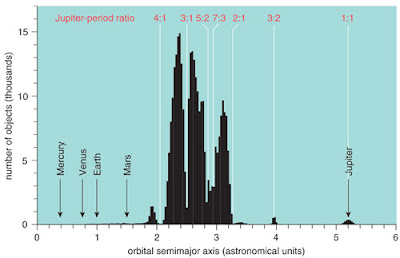
Resonant effects can be clearly seen in the radial distribution of the asteroids. Some orbital resonances are destabilizing, creating minima in the distribution, called "Kirkwood gaps" after Daniel Kirkwood, the astronomer who first recognized them. The main asteroid belt is bounded by the 4:1 and 2:1 orbital resonances with Jupiter. The stable 3:2 and 1:1 resonances account, respectively, for the Hilda family of asteroids and the Jupiter Trojans. The semimajor axis is one-half the long dimension of an object’s elliptical orbit. One astronomical unit is the Earth-Sun distance. Graph by Barbara Aulicino. Distribution of asteroids courtesy of the Minor Planet Center. Are Planetary Systems Filled to Capacity? Computer simulations suggest that the answer may be yes. But observations of extrasolar systems will provide the ultimate test Steven Soter A few years ago, Rory Barnes and Thomas Quinn at the University of Washington used computer simulations to examine the stability of e...

Saiu no PRE de setembro...

Imagem
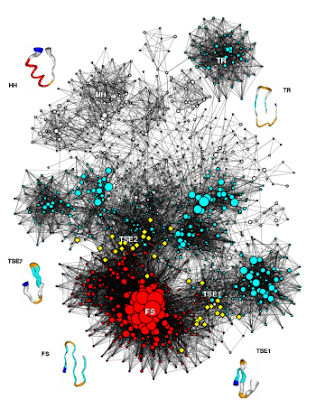
Module identification in bipartite and directed networks Roger Guimerà , Marta Sales-Pardo , and Luís A. Nunes Amaral --> Northwestern Institute on Complex Systems (NICO) and Department of Chemical and Biological Engineering, Northwestern University, Evanston, Illinois 60208, USA (Received 7 June 2007; published 6 September 2007) Modularity is one of the most prominent properties of real-world complex networks. Here, we address the issue of module identification in two important classes of networks: bipartite networks and directed unipartite networks. Nodes in bipartite networks are divided into two nonoverlapping sets, and the links must have one end node from each set. Directed unipartite networks only have one type of node, but links have an origin and an end. We show that directed unipartite networks can be conveniently represented as bipartite networks for module identification purposes. We report on an approach especially suited for module detection in bipartite networks, and...

Por que precisamos dormir?

Imagem
In the coming year, we're going to witness a breakthrough in our understanding of what sleep is for. STEVEN STROGATZ Applied mathematician, Cornell University; Author, Sync . It surprises most people to learn that this is even a question. Every other basic bodily function—like eating, drinking, breathing, urinating, or defecating—has a pretty clear purpose. Our bodies and brains need food, water, and oxygen to stay alive and to replenish themselves, and if they didn't rid themselves of the byproducts of this metabolism, we'd be awash in our own toxic waste. Likewise, sleep must be for something important. We all spend decades in this strange state, immobilized, unconscious, and vulnerable. But what exactly does sleep do for us? Parents tell their children they need to sleep because they're tired and need to rest. But of course rest is not good enough. Lying still for eight hours is no substitute for sleep. My own mother had a different theory. She said I needed to slee...

Referências para a pesquisa com Juliana

Imagem
Potential role of the cannabinoid receptor CB1 in rapid eye movement sleep rebound. Navarro L , Martínez-vargas M , Murillo-rodríguez E , Landa A , Méndez-díaz M , Prospéro-garcía O . Neuroscience. 2003;120(3):855-9. [Cannabinoid receptor 1 expression and pathological changes in rat hippocampus after deprivation of rapid eye movement sleep] [Article in Chinese] Jiang PF , Zhu T , Xia ZZ . Zhejiang Da Xue Xue Bao Yi Xue Ban. 2006 Sep;35(5):535-40. Sleep modulates cannabinoid receptor 1 expression in the pons of rats. Martínez-Vargas M , Murillo-Rodríguez E , González-Rivera R , Landa A , Méndez-Díaz M , Prospro-García O , Navarro L . Neuroscience. 2003;117(1):197-201. Oleamide modulates memory in rats. Murillo-Rodríguez E , Giordano M , Cabeza R , Henriksen SJ , Méndez Díaz M , Navarro L , Prospéro-García O . Neurosci Lett. 2001 Nov 2;313(1-2):61-4. Grupo de Neurociencias, Departamento de Fisiología, Facultad de Medicina, Universidad Nacional Autónoma de México, A Postal 70-250 Mexi...