Post do Roda de Ciênciasábado, março 31, 2007
Uma verdade inconveniente
Post do Roda de Ciênciasexta-feira, março 30, 2007
A Física Estatística do Dona Benta

XXX Encontro Nacional de Física da Matéria Condensada
Copy-mutate processes for growth of bipartite networks: an application to cultural evolution
Universidade de São Paulo
Pedro Zambianchi
Faculdades Bandeirantes
We propose a copy-mutate stochastic process for growth of bipartite networks. We find that its non-equilibrium stationary state, which has scale-free statistics, presents also strong memory effects ("founder effect"). We examine the performance of several algorithm variants, and find that the inclusion of node fitness and competitive selection is essential to reproduce empirical data concerning the bipartite network of culinary recipes and ingredients. The empirical database has been collected from traditional cookbooks from Brazil, England, France and Medieval Europe. We present rank-plots for ingredients and ingredients pairs and study rank-plot entropies. We determine power-law exponents from complementary accumulated distributions and find that all books have similar exponents (with exception of a medieval culinary book). We also examine the temporal evolution of the average recipe fitness and find an asymptotical power law with very low exponent, indicating that the historical process represented by the model is very far from equilibrium. More general applications to cultural evolution ("memetics") are discussed.
quinta-feira, março 29, 2007
Galinhas generalizam de forma Bayesiana
Encontrei isso procurando as recentes citações do meu paper KINOUCHI O, CATICHA N, OPTIMAL GENERALIZATION IN PERCEPTRONSJOURNAL OF PHYSICS A-MATHEMATICAL AND GENERAL 25 (23): 6243-6250 DEC 7 1992
Para meus alunos de Estatística e outros interessados:
Title: Generalization of color by chickens: Experimental observations and a Bayesian model
Author(s): Baddeley RJ (Baddeley, R. J.), Osorio D (Osorio, D.), Jones CD (Jones, C. D.)
Source: AMERICAN NATURALIST 169 (1): S27-S41 Suppl. S, JAN 2007
Document Type: Article
Language: English
Cited References: 48 Times Cited: 0
Abstract: Sensory generalization influences animals' responses to novel stimuli. Because color forms a perceptual continuum, it is a good subject for studying generalization. Moreover, because different causes of variation in spectral signals, such as pigmentation, gloss, and illumination, have differing behavioral significance, it may be beneficial to have adaptable generalization. We report on generalization by poultry chicks following differential training to rewarded (T+) and unrewarded (T-) colors, in particular on the phenomenon of peak shift, which leads to subjects preferring stimuli displaced away from T-. The first three experiments test effects of learning either a fine or a coarse discrimination. In experiments 1 and 2, peak shift occurs, but contrary to some predictions, the shift is smaller after the animal learned a fine discrimination than after it learned a coarse discrimination. Experiment 3 finds a similar effect for generalization on a color axis orthogonal to that separating T+ from T-. Experiment 4 shows that generalization is rapidly modified by experience. These results imply that the scale of a "perceptual ruler" is set by experience. We show that the observations are consistent with generalization following principles of Bayesian inference, which forms a powerful framework for understanding this type of behavior.
quarta-feira, março 28, 2007
Cintra et al.

Prezado Osame,
Vi no seu blog a explicação do "et al.". É a forma abreviada de três locuções latinas e que significa "e outro(a)s".
Essas 3 locuções dependem do sexo dos autores e da expressão ser ativa ou passiva:
1) et alii, para o caso de autores do sexo masculino ou dos dois sexos juntos, e expressões ativas. Exemplo: Silva et alii (eles) concluiram que...
2) et aliae, para o caso de autores somente do sexo feminino, em expressões ativas. Exemplo: Silva et aliae (elas) concluiram que...
3) et allis, para expressões passivas, independente do sexo dos autores. Exemplo: A conclusão apresentada por Silva et allis...
Portanto, a forma abreviada "et al.", em que o ponto indica o fim da abreviatura, cabe sempre e resolve o problema de quem não sabe latim ou não conhece o sexo dos autores.
Abraço,
Cintra
Por falar em latim, recomendo a série ROMA.
terça-feira, março 27, 2007
Ciclo de filmes do Século XXI

Para os Ribeirão Pretanos:
Ciclo de filmes do Século XXI
Agora que já estamos bem dentro do Século XXI é possível começar a ter uma idéia do que vem sendo produzido neste século, em termos científicos, artísticos e culturais. No caso do cinema, este ciclo de 12 filmes procura apresentar uma mostra de produções de diferentes partes do mundo, abordando alguns temas que têm marcado este início de século. Para dar maior legitimidade e imparcialidade ao ciclo, todos os filmes escolhidos receberam premiações em importantes festivais e mostras internacionais. O primeiro filme a ser apresentado é:
Terra de Ninguém. Danis Tanovic, Bósnia-Herzegovina (2001).
Oscar de melhor filme estrangeiro em 2002.
Dia: 30.03.2007
Local: Anfiteatro do bloco didático das exatas (sala 11-DE)
Horário: 16 horas
domingo, março 25, 2007
KNUT e o Beijo de Juliana

José Reinaldo Lopes, do Visões da Vida no G1: É sempre horrível quando você descobre que virou alvo de uma chantagem emocional, daquelas bem safadas, e caiu feito um patinho. Estou me referindo ao sujeito felpudo aí embaixo. A saga do ursinho Knut, órfão de pai, abandonado pela mãe e astro do Zoológico de Berlim, colocou os leitores do G1 em polvorosa nesta semana. Dezenas de e-mails e centenas de comentários no nosso blog rugiam de indignação e revolta. Ninguém conseguia engolir a proposta, feita por alguns ativistas dos direitos dos animais alemães, de sacrificar o bichinho. (O argumento deles: Knut teria uma criação “não-natural” e sofreria demais com a separação inevitável de seu tratador.) Como é que alguém seria capaz de erguer a mão contra uma fofura daquelas?
Vamos admitir: qualquer pessoa normal (OK, menos ativistas alemães) se derrete diante de filhotes como Knut. É um troço visceral. Daí a minha acusação – por favor, não entenda errado – de chantagem emocional. A carinha de um urso-polar bebê é o equivalente psicológico de um golpe baixo, atravessa as nossas defesas, comove corações de pedra. Em certo sentido, não é exagero dizer que a mente humana está programada para gostar do ursinho Knut.
Para ler mais, vá para o Visões da Vida.
Se alguém estiver interessado, o conflito entre a visão cotidiana (crianças são bonitinhas e devem ser protegidas) e a visão do Gene Egoísta (crianças são bonitinhas a fim de serem protegidas) é o tema do livro que nunca será publicado O Beijo de Juliana - Quatro físicos teóricos conversam sobre crianças, ciências da complexidade, biologia, política, futebol e religião.
sábado, março 24, 2007
Este blog realmente funciona!

MCA: Em agosto de 1996, depois de 4 anos no CERN, em Genebra, Suíça, voltei IFT com a idéia de fazer divulgação. Tinha participado do movimento Portas Abertas no CERN. Trouxe material didático da imprensa oficial do CERN, preparei as transparências que levariam esse mundo das partículas elementares ao público brasileiro. O primeiro convite foi do Rotary Club, em abril de 1997, e falei sobre o Discreto charme das partículas elementares. No ano seguinte, falei aos meus conterrâneos, na sede cultural da fábrica de sabão Ypê, em Amparo (SP). Depois vieram convites de alguns colégios e, assim, meu material foi se aperfeiçoando.
Em abril de 1999, fiz o seminário de abertura do evento Encontro ao Entardecer, promovido pelo IFT onde falei sobre o discreto charme das partículas elementares. No ano seguinte, esse seminário abriu novamente o evento e um desdobramento natural do assunto deu-se em abril de 2001, quando falei sobre Os primeiros três minutos do universo. São esses dois temas que constituem este livro, que recebeu leituras importantes e apoio técnico de primeira qualidade de outras fontes.
Em 2002 escrevi o livro sobre a vida e obra de Niels Bohr pela editora Odysseus a convite do Marcelo Gleiser e o livro teve uma ótima receptividade. Está esgotado. Na verdade eu comecei a escrever o livro sobre as partículas antes do livro do Bohr. Depois do livro do Bohr eu voltei ao meu projeto e levei a várias editoras que não deram resposta. Até que eu procurei a editora da UNESP e simultaneamente fiz um pedido de auxílio à FAPESP e ao pró-reitor de pesquisa da unesp. Os dois apoios foram positivos e a editora levou o projeto a diante e o livro acabou saindo em 2006.
Minhas aulas estavam todas erradas!

Sumário
Prólogo.................................................. 1
I. Introdução ...................................... 5
1. A crítica do Dr. Drauzio ............................ 5
2. Forma e conteúdo...................................... 7
3. Oportunidade de sucesso........................... 8
II. Apresentações sem Técnica....... 9
1. Slides inadequados..................................... 9
a) Quantidade ......................................... 9
b) Conteúdo.......................................... 10
2. Postura incorreta .................................... 10
a) Leitor de slides.................................. 11
b) Refém da projeção ........................... 11
c) Papel desnecessário .......................... 11
d) Conhecimento não demonstrado .... 11
III. Equipamentos de Projeção .... 13
1. Lousa .........................................................13
2. Projetor de slides de 35 mm ................... 13
3. Retroprojetor............................................ 15
4. Projetor multimídia................................. 16
IV. Base Conceitual dos Slides..... 17
1. Meios e padrões de comunicação ............ 17
2. Não ao padrão-livro.................................. 19
a) Palavras-chave ................................. 19
b) Strip-tease ....................................... 19
c) Animação ......................................... 20
d) Não auto-explicativo........................ 20
V. Os Slides.......................................... 23
1. Recomendações ........................................ 31
2. Alertas .......................................................32
3. O papel dos slides.................................... 32
VI. Comunicação Frente a Frente 31
1. Microcomputador ................................... 25
2. Controle remoto...................................... 26
3. Apontador a laser ................................... 26
VII. Interrupção da Projeção...... 35
1. No-show .................................................. 36
2. Slide de transição .................................... 36
Viii. Discurso Ilustrado por Slides 39
IX. Cenário da Apresentação........ 41
1. Iluminação ............................................... 42
2. Lay-outs................................................... 42
3. Púlpito e mesa ........................................ 43
4. Cuidados....................................................44
X. Recursos de Oratória ............... 47
1. Corporais................................................... 47
a) Movimentação ................................. 47
b) Gesticulação .................................... 47
c) Supressão de cacoetes...................... 48
d) Voz ................................................... 48
2. Psicológicos ............................................. 49
a) Calma ............................................... 49
b) Humor.............................................. 50
c) Entusiasmo ...................................... 50
d) Reação ao público............................ 50
3. Discursivos.............................................. 50
a) Nível de linguagem .......................... 51
b) Motivação inicial............................... 51
c) Auto-apresentação .......................... 52
d) Desculpa e modéstia........................ 52
e) “Lei de Ricupero” ............................ 52
4. Interativos ............................................... 53
a) Interação .......................................... 53
b) Indução de conclusões .................... 54
c) Encerramento .................................. 54
d) Respondendo perguntas.................. 55
XI. A Timidez e o Medo de Falar em Público 57
1. “Teoria” da Moeda ................................... 57
2. A representação de um personagem ..... 58
XII. Ensaios.......................................... 61
1. Objetivos ................................................... 61
a) Representação .................................. 61
b) Tempo.............................................. 62
c) Slide de transição ............................ 63
2. Como ensaiar........................................... 63
a) Sem data-show................................ 63
b) Ensaios inteiros ............................... 64
c) Gravação .......................................... 64
d) Não decorar ..................................... 64
e) Não escrever .................................... 64
XIII. Tipos de Apresentação .......... 67
1. “Tô nem aí” .............................................. 67
2. Guia de museu ........................................ 67
3. Ator principal .......................................... 68
XIV. Solução à Crítica do Dr. Drauzio 69
XV. Conclusão ................................... 73
sexta-feira, março 23, 2007
Promessas de Prometeu

Diz Marcelo Leite, em seu post do dia 20/03:
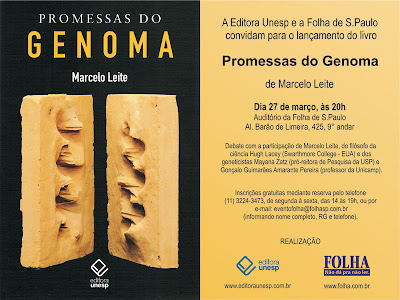
Meu novo livro, Promessas do Genoma (Editora da Unesp, 243 páginas, R$ 30,00), será lançado na terça-feira (27/3) com um debate no auditório da Folha, às 20h. Depois detalho aqui como obter uma vaga para assistir ao conclave, que contará com a participação do filósofo da ciência Hugh Lacey e com os geneticistas Mayana Zatz (USP, pró-reitora de Pesquisa) e Gonçalo Guimarães Amarante Pereira (Unicamp).
Em lugar de mais uma das pílulas antideterministas do Dr. Leite, que tanta polêmica já causaram aqui, o livro pretende ser uma quimioterapia inteira contra os tumores hiperbólicos aderidos ao Projeto Genoma Humano. Primeiramente pelos próprios biólogos moleculares, depois alegremente secundados pela maior parte de nós, jornalistas de ciência.
Boa parte dos leitores deste blog vai odiar Promessas do Genoma. Como hoje em dia há quem acredite que os sentimentos possam espicaçar a razão, não perco a esperança de que o livro contribua com alguma substância ao debate. Se um biólogo molecular se dispuser a ler Lenny Moss, Lily Kay, Susan Oyama, Dick Lewontin, Michel Morange, Horace Freeland Judson, Sahotra Sarkar, Herminio Martins, Laymert Garcia dos Santos, Hugh Lacey, Paul Rabinow ou Evelyn Fox Keller (qualquer um deles) depois de encará-lo, terá valido a pena.
Ainda que ninguém trafegue pela via que separa as duas culturas (humanidades e ciências naturais), além dos cachorros loucos, a estrada é de duas mãos.
P.S.: Se você estiver encafifado com a bela imagem da capa do livro, saiba que se trata da obra DNA, de Nuno Ramos (Areia, resina, CO2; 2003), fotografada por Eduardo Knapp (Folha Press).
quarta-feira, março 21, 2007
Adeus, Fortran!

| Morre criador da primeira linguagem de programação | |
Foi o Fortran que transformou a programação e a tornou mais próxima da compreensão do homem. Antes, a programação era muito complexa e necessitava muito estudo. De acordo com Ken Thompson, criador do Unix, 95% dos programadores de antigamente nunca teriam condições de exercer sua profissão se não fosse pelo Fortran.
Sonhos e Odores

Da Nature Reviews Neuroscience:
Odor cues during slow-wave sleep prompt declarative memory condolidation
Rasch, B. et al. Science 315, 1426–71429 (2007)
It is thought that new memories are consolidated during sleep because they are replayed in the brain. Rasch et al. show that presenting an olfactory stimulus during slow-wave sleep boosted the memory of a previously learned task, but only if the smell had also been present during learning. Functional MRI showed hippocampal activation in response to odour exposure during slow-wave sleep, providing evidence that the memory-boosting effect of re-exposure to a smell during sleep might be associated with replaying memories in the hippocampus.
Na teoria de consolidação clássica, não está claro como as memórias migram do hipocampo para o cortex, e como são apagadas no hipocampo. Já discuti bastante com o Sidartha que a simples superposição de memórias no hipocampo não apaga as anteriores, mas apenas causa sobrecarga e confusão na rede, pelo menos nos modelos de redes neurais de atratores - que são os únicos modelos computacionais viáveis que memórias Hebbianas que temos por enquanto.
Idéia para o Sidartha: o resíduo diário Freudiano se dá no sono não-REM, os sonhos ligados a memórias e traumas emocionais, desejos obsessivos e medos ansiosos se dá no sono REM.
terça-feira, março 20, 2007
O que é R?

Introduction to R
R is a language and environment for statistical computing and graphics. It is a GNU project which is similar to the S language and environment which was developed at Bell Laboratories (formerly AT&T, now Lucent Technologies) by John Chambers and colleagues. R can be considered as a different implementation of S. There are some important differences, but much code written for S runs unaltered under R.
R provides a wide variety of statistical (linear and nonlinear modelling, classical statistical tests, time-series analysis, classification, clustering, ...) and graphical techniques, and is highly extensible. The S language is often the vehicle of choice for research in statistical methodology, and R provides an Open Source route to participation in that activity.
One of R's strengths is the ease with which well-designed publication-quality plots can be produced, including mathematical symbols and formulae where needed. Great care has been taken over the defaults for the minor design choices in graphics, but the user retains full control.
R is available as Free Software under the terms of the Free Software Foundation's GNU General Public License in source code form. It compiles and runs on a wide variety of UNIX platforms and similar systems (including FreeBSD and Linux), Windows and MacOS.
The R environment
R is an integrated suite of software facilities for data manipulation, calculation and graphical display. It includes
- an effective data handling and storage facility,
- a suite of operators for calculations on arrays, in particular matrices,
- a large, coherent, integrated collection of intermediate tools for data analysis,
- graphical facilities for data analysis and display either on-screen or on hardcopy, and
- a well-developed, simple and effective programming language which includes conditionals, loops, user-defined recursive functions and input and output facilities.
The term "environment" is intended to characterize it as a fully planned and coherent system, rather than an incremental accretion of very specific and inflexible tools, as is frequently the case with other data analysis software.
R, like S, is designed around a true computer language, and it allows users to add additional functionality by defining new functions. Much of the system is itself written in the R dialect of S, which makes it easy for users to follow the algorithmic choices made. For computationally-intensive tasks, C, C++ and Fortran code can be linked and called at run time. Advanced users can write C code to manipulate R objects directly.
Many users think of R as a statistics system. We prefer to think of it of an environment within which statistical techniques are implemented. R can be extended (easily) via packages. There are about eight packages supplied with the R distribution and many more are available through the CRAN family of Internet sites covering a very wide range of modern statistics.
segunda-feira, março 19, 2007
Ainda o II Simpósio do IINN-ELS

domingo, março 18, 2007
Paleo-futuro

I first came across the word "Paleo-Future" in a Flickr group of the same name. However, the topic first sparked my interest when I visited Walt Disney World's EPCOT Center, (now Epcot), and realized that Disney's version of the future was based upon what they thought the future would look like in the 1980s. As is important when depicting the future, your opinions must change with the times, unless you happen to be omnipotent, which means you have no need to revise your vision of the future and have probably used your powers for such noble endeavors as guessing my weight at the local carnival or writing horoscopes that tell me, "you should find time for yourself tonight."While I might poke fun at the outlandish ideas of 1950s America, corporate puffery, or Jules Verne I do it with an admiration for the idealism we seem to be losing in our post-modern society. The belief that technology has the potential to improve the lives of everyone on Earth seems rare. Just remember that an optimism for the future and the attempt to better the world for all humanity is hidden somewhere within each sarcastic comment about flying cars and space farms. In that same vein, I will always remember that the dystopian societies depicted by George Orwell or Alan Moore are just as plausible if we surrender freedom in the name of security. Here's to a "great big beautiful tomorrow."
Thanks for reading,Matt
sábado, março 17, 2007
Escolas alemãs recebem 6 mil cópias de "Uma Verdade Inconveniente"

sexta-feira, março 16, 2007
Por que escolher este blog?
Sem muito tempo para blogar hoje, estou com Leonardo e Raphael - que fez 4 anos anteontem. Assim, vai aqui uma resenha da Nature que achei interessante, especialmente para aqueles que têm uma mulher viciada em bingo como eu.
Does human creativity stem from a process that turns arbitrary ideas into goals like food and sex?
BOOK REVIEWED-Why Choose This Book? How We Make Decisions
by Read Montague
Dutton: 2006. 331 pp. $24.95, £15.99

R. BAMBER/ALAMY
Neat trick: activities such as gambling and card games can supplant the basic rewards of food or sex.
Why don't our brains get as hot as the processors in our personal computers? And what does that tell us about biological computation, the nature of choice, the value of value signals, and the power of ideas? These questions may seem rather disparate, but Read Montague's provocative and accessible treatment of them in Why Choose This Book? displays a deep and unexpected unity. The story goes something like this. Biological computation is constrained to be efficient: to confer close to maximal computational power for close to minimal energetic expenditure. The outward sign of this efficiency is said to be the mere warmth of the human brain compared with the searing (wasted) heat of those computer processors. To be efficient, biological computations need to be equipped, so the argument goes, with some kind of measure of their own value, in relation to the in-built goals of maintaining life and reproductive success. Such measures allow the system to expend energy only on those computations that matter most. How such a measure might work remains problematic, but once it is in place, general principles of thrifty processing, such as the slow use of power, compression of data, conservation of wiring, and frugal use of bandwidth and communication, are all recruited to the mix.
But it is the goals and value signals that play the lead role in Montague's story. He introduces us to the guiding principle that will link efficiency to choice and to the power (and pathologies) of ideas. That principle, familiar enough in cognitive scientific circles but here tweaked and nuanced in novel and potentially transformative ways, goes by the unpromising name of 'reinforcement learning'. In reinforcement learning, goal states are approached by sensitivity to signals that predict rewards (the attainment of goals). But the system is not simply hardwired to regard only some fixed set of signals as reward signals; it obtains flexibility by learning associations between experienced signals and temporally removed (but consistently associated) rewards. Past experience of what signal leads to what reward is thus combined with present feedback (what's here now, and what is it worth?) to generate choices that (ideally) maximize total future reward.
Moving all this along is the 'reward-prediction error signal', which carries information about how well the actual rewards tally with the predicted rewards. When the actual reward exceeds the predicted one, it makes sense to upgrade the stored value of the states that predicted the unexpectedly greater reward. In the brain, dopamine neurons provide at least one means of mechanistically encoding just such a reward-prediction error signal. Bursts of dopaminergic activity result when the reward exceeds the predicted reward; pauses in activity mean that the reward falls short of the predicted reward; and unchanged activity means the reward was as expected.
But what counts as a reward anyway? The most obvious rewards are the basic biological achievements of life maintenance (such as the ingestion of a tasty and nourishing morsel) and reproduction (or rather its precursor, sexual intercourse). Montague is motivated, however, by a strong desire to unravel the mechanistic underpinnings of what he describes as a uniquely human 'superpower': the capacity to make choices that seem to value biologically arbitrary objects, achievements and actions. Examples of such biologically arbitrary goal states mentioned in the text include solving Fermat's last theorem and committing group suicide in the belief that a spaceship hidden in a comet's tail will then take you to 'the next level'. What makes all this possible, in Montague's model, is the capacity of ideas themselves to act as reward signals, hijacking the prediction-error systems implemented by dopamine neurons in the brain. When this happens, the dopamine outputs start to act as error signals that encourage the rest of the brain to learn and to make decisions in ways that increase the chances of acquiring some biologically arbitrary reward.
Given the potentially biologically catastrophic consequences of such re-tooling of mere thoughts as rewards, Montague suggests that powerful filtering processes control what gets into the reward slot. But such processes can be fooled — in ways that the book describes in compelling and often sinister detail — by damage, by drug abuse, and perhaps even by some forms of advertising and branding (brands are just cues that predict rewards). Montague's proposal is that biologically arbitrary goals can somehow plug into a kind of 'special status reward socket', and thus become a basic, primary reward, like food or sex. He does not claim that these ideas become associated, either directly or indirectly, with food or sex; rather, they plug directly into the 'socket' normally occupied only by the most basic high-status rewards. If we humans have indeed learnt such a powerful trick, it is no surprise that it fuels so much that is both good (creative and expansive) and ill (pathological and restrictive) in our species. Montague begins by laying out this possibility, then follows it deep into the fascinating territories of creative thought, addiction, obsessive–compulsive disorder, Parkinson's disease, and then on to the psychosocial realms of trust and regret.
Despite its attractions, there are some important mechanistic gaps in the story, as Montague acknowledges. For example, it isn't clear why or how one idea might win out over another in the bid to occupy a high-status reward socket, or how the occupation itself is accomplished. Nor is it really clear when such occupation should be deemed pathological rather than creative. I was also left wondering whether the basic idea of each symbol and each computation carrying its own value 'tag' — the difference, Montague argues, between standard computational models using 'meaningless symbols' and the hyper-efficient, value-rich computations said to be characteristic of biological nervous systems — is sufficiently clear and workable. Exactly how do these computation-value or symbol-value pairs work, and how do they transform mere symbol processing into meaning? Do they compose? Two computations whose individuals values are low might together constitute a complex computation whose value to the organism is high, but Montague suggests no way of systematically predicting such combined values from the values assigned to the parts.
Perhaps I am missing something, but it repeatedly struck me that Montague's overall vision is both rather more radical, and rather less mechanistically clear, than his book suggests. The prospective reader should be aware that the story on offer actually departs quite a long way from the basic computational theory of the mind. It builds in value and computation right down to the cellular level, and (more generally) systematically blurs the usual distinctions between life, mind and information processing. This blurring is evident, for example, in the puzzling idea that each individual neuron, in the quest for efficient interneural communication, might need to contain up to 100 million 'dynamic models' of other neurons and neuronal subsystems.
These are not really complaints, however. The book spans several seldom-bridged worlds, from neuroscience to psychiatry, economics and social psychology, and does so with wit, precision and elegance. It succeeds in many of its goals. Above all, it left me feeling I had actually learnt something about myself: a thinking, feeling, choosing, yet painfully vulnerable chemically modulated learning machine.
- Andy Clark is at the School of Philosophy, Psychology and Language Sciences, University of Edinburgh, Edinburgh EH8 9JX, UK.
Livros de Estatística (I)

Atenção, pessoal dos cursos de Estatística Aplicada I (Psicologia - FFCLRP - USP) e Introdução à Probabilidade e Estatística I (Economia - FEARP -USP). Pretendo adotar (e testar) este livro durante todo este ano. Por favor, não façam xerox (pois pretendo usar todo o livro, não apenas alguns capítulos). Troquem uma noite na Água Doce Cachaçaria por este livro que será bastante útil para sua formação profissional.
ESTATÍSTICA GERAL E APLICADA
Gilberto de Andrade Martins
428 páginas - 3ª Edição (2005) - 2ª Tiragem
| Formato: 17X24 ISBN: 8522441723 Código: 0603 55 086 | ||
Sinopse:
Este livro é resultado de longa experiência profissional do autor no campo da Estatística Geral e Aplicada, Cálculo das Probabilidades e Metodologia Científica, disciplinas lecionadas e aplicadas nos cursos de graduação e pós-graduação, nas áreas de Humanas e Exatas.
O objetivo básico desta publicação é estimular e energizar alunos e profissionais interessados em compreender e aplicar, com segurança, conhecimentos técnicos da Estatística para tomada de decisões e suporte às análises de resultados quantitativos e qualitativos de pesquisas empírico-analíticas.
quarta-feira, março 14, 2007
Partido dos Baixinhos
Afirmei que os baixinhos, ou melhor, as pessoas com altura com menos de um desvio padrão abaixo da média - PAMDPAM (acho que este é o termo PC) eram discriminados. Citei algumas estatísticas que mostravam que baixinhos, desculpe, os PAMDPAM, ganham menos que seus pares, são preteridos em promoções, são preteridos em cargos de liderança (você já notou como os presidentes americanos são em geral altos?) etc. E, é claro, existe essa mania das mulheres de colocar 1,70 (ou mesmo 1,74 - mas raios, por que 1,74em vez de 1,75?) como a altura mínima no Yahoo Encontros.
Bom, ela concordou, militante que era, e disse: bom, por que você não inicia um movimento nacional em defesa dos baixinhos?
Eu pensei que ela estava brincando, mas o pior foi que ela estava falando sério.
Final da história: não, eu não fundei o PB (Partido dos Baixinhos) nem o movimento nacional em defesa dos PAMDPAM. Mas a idéia é boa, deixo para você, meu leitor PAMDPAM tentar...
da Ansa, em Londres
Os homens de baixa estatura eram irresistíveis para as mulheres na pré-história, pelo menos até que descobriram as armas. Essa diferença em relação aos cânones atuais de beleza é a tese central de um estudo da universidade norte-americana de Utah, que apareceu nesta quarta-feira na versão eletrônica do jornal "The Times".
| Divulgação |
Austrolopithecus africanus, que viveu na época em que baixinhos seriam os preferidos" border="0" height="175" width="230"> |
| Austrolopithecus africanus, que viveu na época em que baixinhos seriam os preferidos |
"As pernas curtas asseguravam aos Australopithecus o êxito em combate", explicou o professor David Carrier em um artigo publicado na revista "Evolution", citado pelo Times on-line.
"Os Australopithecus mantiveram as pernas curtas durante dois milhões de anos porque um físico compacto e mais estável ajudava os varões a combater pelas mulheres", revela o professor em sua pesquisa, e explica que os homens mais baixos eram os mais agressivos.
Segundo Carrier, esse antepassado do homem media 1,35 m. Com a introdução das primeiras armas, 2 milhões de anos atrás, o homem da caverna passou a utilizar objetos para se defender e as normas estéticas mudaram.
O que são Mapas de cointegração?

Figura: foi a única que achei fazendo a busca Renato Vicente no Google Images; retirada daqui (ele cita o índice de Hirsh individual h_i!).
terça-feira, março 13, 2007
Por que eu faço posts sobre a Nicole Kidman?
Dado que o SEMCIÊNCIA é pretensamente um blog de divulgação científica (ou pelo menos de auto-promoção científica), muita gente me pergunta. Por que Nicole Kidman?Update: A Wikipedia informa que na verdade Kidman é levemente ruiva.
Desenhando a Ciência

segunda-feira, março 12, 2007
Mais blogs de ciência

domingo, março 11, 2007
Seja o visitante 22500!

- Quinto colocado: Visitante número 22.000 - Prêmio: um livro qualquer de FC que estiver sobrando na minha biblioteca. (Este o Mauro Copelli já ganhou: O Homem ilustrado, de Ray Bradbury)
- Quarto colocado: Visitante número 22.500 - Prêmio: dois livros da coleção Argonauta, repetidos, é claro.
- Terceiro colocado: Visitante número 23.000 - Prêmio: livro Os Três Estigmas de Palmer Eldrich, de Philip K. Dick, ou outro do PKD.
- Segundo colocado: Visitante número 23.500 - Prêmio: livro Os Despossuídos, de Ursula K. Le Guin, versão Clube do Livro.
- Primeiro colocado: Visitante número 24.000 -Prêmio: livro Solaris, de Stanislaw Lem, versão Clube do Livro. Se eu achar o His Master's Voice baratinho, pode ser esse também.
Man's quest for knowledge is an expanding series whose limit is infinity, but philosophy seeks to attain that limit at one blow, by a short circuit providing the certainty of complete and inalterable truth. Science meanwhile advances at its gradual pace, often slowing to a crawl, and for peiriods it even walks in place, but eventually it reaches the various ultimate trenches dug by philosophical thought, and, quite heedless of the fact that it is not supposed to be able to cross those final barriers to the intellect, goes right one.How could this not drive the philosophers to despair? One form of that despair was Positivism, remarkable in its hostility, because it played the loyal ally of science but in fact sought to abolish it. The thing that had undermined and destroyed philosophy, annulling its great discoveries, now was to be severely punished, and Positivism, the false friend, passed that sentence - demonstrating that science could not truly discover anything, inasmuch as it constituted no more than a shorthand record of experience. Positivism desired to muzzle science, to compel it somehow to declare itself helples in all transcendental matters (which, however, as we know, Positivism failed to do).The history of philosophy is the history of successive and nonidentical retreats. Philosophy first tried to discover the ultimate categories of the world; then the absolute categories of reason; while we, as knowledge accumulates, see more and more clearly philosophy's vulnerability: because every philosopher must regard himself as a model for the entire species, and even for all possible sentient being. But it is science that is the transcendence of experience, demolishing yesterday's categories of thought. Yesterday, absolute space-time was overthrown; today, the eternal alternative between the analytic and the synthetic in propositions, or between determinism and randomness, is crumbling. But somehow it has not occurred to any of our philosophers that to deduce, from the pattern of one's own thoughts, laws that hold for the full set of people, from the eolithic until the day the suns burn out, might be, to put it mildly, imprudent.
Se você não entendeu a foto, clique aqui.
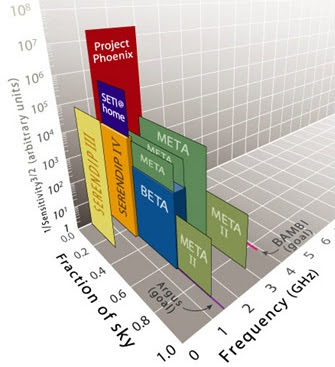
WWW galáctica

Trying to Meet the Neighbors
By DAVE ITZKOFF
Published: March 11, 2007
Is there anybody out there? Give the question some thought before you answer, because it’s more perilous than it seems. Deny the possibility of a universe populated with intelligent extraterrestrials that can speak and mate and battle with humanity, and the science-fiction canon collapses; more than a century’s worth of novels, from “The War of the Worlds” to “Old Man’s War,” would find their speculative foundations swept out from underneath them. But admit to a sincere belief in the remotest potential for alien life, and prepare to be fitted for a straitjacket; a recent survey conducted by Baylor University found that more Americans believe in ancient civilizations like the lost continent of Atlantis than in U.F.O.’s.
(...)
Surprisingly, the science-fiction community (which knows a thing or two about being misunderstood and dismissed) is not unequivocally supportive of SETI’s work. In a 2003 lecture entitled “Aliens Cause Global Warming,” Michael Crichton declared, “SETI is unquestionably a religion.” And authors free of Crichton’s political baggage do not cast SETI’s mission in particularly upbeat terms, either: in his short story “The Puzzle,” the Serbian author Zoran Zivkovic writes of a scientist pursuing a SETI-like experiment, whose “gloomy exultation” can end only with irrefutable evidence of extraterrestrial intelligence — only “with contact made would he be able to say that his life’s work had meaning.”(...)
Using massive radio telescopes, SETI hopes to detect electromagnetic transmissions coming from these potential neighborhoods. In the past decade, Shostak estimates, the institute has looked at 750 star systems, but within the next 25 years it should be able to scan one million to two million more. And he is fond of betting his interrogators a cup of Starbucks that the question of whether mankind is alone in the universe will be settled by the year 2025.
(...)
Robyn Asimov, the daughter of the science-fiction master Isaac Asimov, has become a friend of the SETI Institute despite her upbringing: Dad was more of a robot guy than an alien guy, and agnostic on the subject of extraterrestrial intelligence, except for one instance when father and daughter mistook the Goodyear blimp for a U.F.O. (“He nearly had a heart attack,” she told me in a telephone interview. “He thought he saw his career going down the drain.”)
In our conversation, she explained to me why SETI research is still valuable, even if scientists like Shostak never find any Daleks, Vulcans or Wookiees. “My father knew he wouldn’t live to see space travel as he wrote about it, or robots acting in the way he wrote about them, and he was fine with that,” Asimov said. “His major thrust, and I think Seth’s and SETI’s as well, is to get people interested in science, and doing something about it, and then handing the baton over to the next generation. It’s an almost egoless outlook, because the intellectual curiosity is what takes priority.”
sábado, março 10, 2007
Empates

Date: Thu, 8 Mar 2007 11:45:47 GMT (178kb)
From 2000 Bush-Gore to 2006 Italian elections: Voting at fifty-fifty and the Contrarian Effect
A sociophysical model for opinion dynamics is shown to embody a series of recent western hung national votes all set at the unexpected and very improbable edge of a fifty-fifty score. It started with the Bush-Gore 2000 American presidential election, followed by the 2002 Stoiber-Schr\H{o}der, then the 2005 Schr\H{o}der-Merkel German elections, and finally the 2006 Prodi-Berlusconi Italian elections. In each case, the country was facing drastic choices, the running competing parties were advocating very different programs and millions of voters were involved. Moreover, polls were given a substantial margin for the predicted winner. While all these events were perceived as accidental and isolated, our model suggests that indeed they are deterministic and obey to one single universal phenomena associated to the effect of contrarian behavior on the dynamics of opinion forming. The not hung Bush-Kerry 2005 presidential election is shown to belong to the same universal frame. To conclude, the existence of contrarians hints at the repetition of hung elections in the near future.
quinta-feira, março 08, 2007
Contato


Austrolopithecus africanus, que viveu na época em que baixinhos seriam os preferidos" border="0" height="175" width="230">